Blog

Featured

Meanwhile… a poll!

Hey everyone!

We’re putting out the last two scenarios in the Lockdown arc, as well as the last two Playable Characters in the “core” box: Father Cosmos and High-Rise. Father Cosmos manifests energy into shapes with physical form, enhancing his allies and hindering his foes. High-Rise can change sizes to maximize her damage to enemies while minimizing adverse effects to herself. These characters are fairly high-complexity, but if you have a player on your team that enjoys experimenting with inter-dependent effects (or you are that player on your team), they can really rocket your team to victory!

With the Lockdown arc out in the wild, we wanted to give you all the opportunity to request what arc we put out next! We have 6 total co-op arcs, although two of those did not see any playtesting, as there were other focuses during active development. Whatever Co-op arc is chosen will also dictate which Threats are shown next, as well as the Environment deck that is associated with the arc. The core premise of each of the remaining arcs’ settings were born from the question “What if X villain had actually succeeded in their goals, to one degree or another?”, so each setting definitely leans way in to a specific theme. We hoped that this would allow players to jump right in without requiring too many panels of introduction in the scenario books, and that future expansions would give us more leeway on longer-form theme-building and setting descriptions.

All that being said: Here are your choices for the next co-op arc to release!
1) Despair: A setting where a nefarious cult has succeeded in summoning their dread god from an otherworldly realm, bringing despondency to the world and forcing world leaders to acquiesce to the demands of this cult and its terrible deity. Threats include: Ennui, Dreadlord, Chosen of Despair, The Ancient Despair.
2) Outbreak: A setting wherein a Virulent plague has run its course unabated, morphing all humans into a beast-like form and forcing most to lose their higher-level cognition. Threats include: Plague Beast, Plague King, and Vector.
3) Antibodies: A setting where everything is normal. Nothing at all is out of the ordinary. Why ever would you ask what’s wrong with this world? You must not be from around here, let me help you get settled in. Threats include: Muscle, Marionette, Fleshpit, Bodybuilder.

We’ll close out voting on Sunday August 23, to give us time to write up an introductory post about the winning setting.

We are continuing our studies into Black Lives Matter with Ibram X. Kendi’s How to be an Antiracist:

Definitions anchor us in principles. This is not a light point: If we don’t do the basic work of defining the type of people we want to be in language that is stable and consistent, we can’t work toward stable, consistent goals. Some of my most consequential steps towards being an antiracist have been the moments when I arrived at basic definitions. To be an antiracist is to set lucid definitions of racism/antiracism, racist/antiracist policies, racist/antiracist ideas, racist/antiracist people. To be a racist is to constantly redefine racist in a way that exonerates one’s changing policies, ideas, and personhood.

So let’s set some definitions. What is racism? Racism is a marriage of racist policies and racist ideas that produces and normalizes racial inequities. Okay, so what are racist policies and ideas? We have to define them separately to understand why they are married and why they interact so well together. In fact, let’s take one step back and consider the definition of another important phrase: racial inequity.

Racial inequity is when two or more racial groups are not standing on approximately equal footing. Here’s an example of racial inequity: 71 percent of White families lived in owner-occupied homes in 2014, compared to 45 percent of Latinx families and 41 percent of Black families. Racial equity is when two or more racial groups are standing on relatively equal footing. An example of racial equity would be if there were relatively equitable percentages of all three racial groups living in owner-occupied homes in the forties, seventies, or, better, nineties.

A racist policy is any measure that produces or sustains racial inequity between racial groups. An antiracist policy is any measure that produces or sustains racial equity between racial groups. By policy, I mean written and unwritten laws, rules, procedures, processes, regulations, and guidelines that govern people. There is no such thing as a nonracist or race-neutral policy. Every policy in every institution in every community in every nation is producing or sustaining either racial inequity or racial equity between racial groups.

Ibram X. Kendi “How to be an Antiracist”

As before, the most up to date Print and Play materials are in the Dropbox, and the Tabletop Simulator mod should be up to date as well. Thanks to darleth on Steam for helping us troubleshoot the mod and letting us know when we’ve misconfigured things! =]

–Smith at the Forge
Featured

Meanwhile… A Scenario emerges!

Welcome back! The last time we spoke, we had forgotten to put the Cooperative threats in the folder, but the first two are in there now! We’ve also uploaded the first scenario that we’re showing off, where the Guardians are sent into an interdimensional “Hyperspace Alternative Violence Eradication Nexus” to try and prevent the facility from jumping through realities without any control.

We’ve also added three more playable characters, as well as the full rulebook. As with all of the Meanwhile content, the rules are fairly complete; however, there are still edge cases and situations that are not covered, so please feel free to ask about anything that seems to be missing or unclear. The three new characters are a small increase in complexity from the Quickstart characters, with Squall and the Accompanist heavily using their Meanwhile slots to maintain and amplify ongoing abilities.

The Scenario calls for a number of new tokens that have been added to the token sheet in the dropbox, as well as a Secrets Bag filled with some Secret tokens. If you would prefer not to utilize tokens this way for any reason, you can also shuffle an Ace-6 set of cards or roll a six-sided die to achieve the same result. This Scenario also introduces an Environment Deck that is used to bring the setting of the scenario to life a little more and give players an additional measure of challenge.

Continuing our study of Abolition, we have included a passage from the first chapter of Are Prisons Obsolete? by Angela Davis.

The prison therefore functions ideologically as an abstract site into which undesirables are deposited, relieving us of the responsibility of thinking about the real issues afflicting those communities from which prisoners are drawn in such disproportionate numbers. This is the ideological work that the prison performs-it relieves us of the responsibility of seriously engaging with the problems of our society, especially those produced by racism and, increasingly, global capitalism. What, for example, do we miss if we try to think about prison expansion without addressing larger economic developments? We live in an era of migrating corporations. In order to escape organized labor in this country-and thus higher wages, benefits, and so on-corporations roam the world in search of nations providing cheap labor pools. This corporate migration thus leaves entire communities in shambles. Huge numbers of people lose jobs and prospects for future jobs. Because the economic base of these communities is destroyed, education and other surviving social services are profoundly affected. This process turns the men, women, and children who live in these damaged communities into perfect candidates for prison. In the meantime, corporations associated with the punishment industry reap profits from the system that manages prisoners and acquire a clear stake in the continued growth of prison populations. Put simply, this is the era of the prison industrial complex. The prison has become a black hole into which the detritus of contemporary capitalism is deposited. Mass imprisonment generates profits as it devours social wealth, and thus it tends to reproduce the very conditions that lead people to prison. There are thus real and often quite complicated connections between the de-industrialization of the economy-a process that reached its peak during the 1980s-and the rise of mass imprisonment, which also began to spiral during the Reagan-Bush era. However, the demand for more prisons was represented to the public in simplistic terms. More prisons were needed because there was more crime. Yet many scholars have demonstrated that by the time the prison construction boom began, official crime statistics were already falling. Moreover, draconian drug laws were being enacted, and “three-strikes” provisions were on the agendas of many states.

In order to understand the proliferation of prisons and the rise of the prison industrial complex, it might be helpful to think further about the reasons we so easily take prisons for granted. In California, as we have seen, almost two-thirds of existing prisons were opened during the eighties and nineties. Why was there no great outcry? Why was there such an obvious level of comfort with the prospect of many new prisons? A partial answer to this question has to do with the way we consume media images of the prison, even as the realities of imprisonment are hidden from almost all who have not had the misfortune of doing time. Cultural critic Gina Dent has pointed out that our sense of familiarity with the prison comes in part from representations of prisons in film and other visual media. The history of visuality linked to the prison is also a main reinforcement of the institution of the prison as a naturalized part of our social landscape.

Angela Davis “Are Prisons Obsolete?”
Chapter 1. Introduction: Prison Reform or Prison Abolition?

As before, all of the material for the Meanwhile system Print and Play will be in this folder, and we will do our best to keep the scenario content organized in this sub-folder.

Also, the United States is continuing to have multiple cities with protests against police violence, and federal agents are beginning to deploy to cities in record numbers to assist local police in delivering state violence on protesters. Please find a local bail fund to contribute to, as detention for protesters often happens with no way to mitigate the possible transmission of COVID-19.

–Smith at the Forge

Meanwhile… in your printer!

Featured

Hello everyone!
We finally have a Print and Play and Tabletop Simulator mod for the Quickstart mode of the Meanwhile System! This is only the six most basic characters that we felt eased new players into how the rest of the system played. If you were ever fortunate enough to find us running a demo of the game, you’ll probably be very familiar with these squads and how they operate.

For those of you who are eager to see the breadth of what we put together (characters, maps, scenarios, etc.), we will be posting smaller chunks of that content over the next couple months as they are transitioned thematically, likely in two-week bits. As we mentioned a few weeks ago, we have opened up a call for new playtesters, as we have a few games in active development that we can always use new eyes on. If this Quickstart content has you excited for more, please join our community and help us make this the best it can be!

Before we link to the Print and Play content, as part of our ongoing education, we’re continuing to read material from Angela Davis, this time from an interview conducted by Frank Barat, and collected in Freedom is a Constant Struggle:

What does it say about the Black civil rights movement that more than fifty years after MLK and Malcolm X, the targeting of Black people, Latinos/Latinas, is still happening? Does that mean that the Black civil rights movement has failed or that it’s a continuous struggle?

The use of state violence against Black people, people of color, has its origins in an era long before the civil rights movement—in colonization and slavery. During the campaign around Trayvon Martin, it was pointed out that George Zimmerman, a would-be police officer, a vigilante, if you want to use that term, replicated the role of slave patrols. Then as now the use of armed representatives of the state was complemented by the use of civilians to perform the violence of the state.

So we don’t have to stop at the era of the civil rights movement, we can recognize that practices that originated with slavery were not resolved by the civil rights movement. We may not experience lynchings and Ku Klux Klan violence in the same way we did earlier, but there still is state violence, police violence, military violence. And to a certain extent the Ku Klux Klan still exists.

I don’t think this means that the civil rights movement was unsuccessful. The civil rights movement was very successful in what it achieved: the legal eradication of racism and the dismantling of the apparatus of segregation. This happened and we should not underestimate its importance. The problem is that it is often assumed that the eradication of the legal apparatus is equivalent to the abolition of racism. But racism persists in a framework that is far more expansive, far vaster than the legal framework.

Economic racism continues to exist. Racism can be discovered at every level in every major institution—including the military, the health care system, and the police.

It’s not easy to eradicate racism that is so deeply entrenched in the structures of our society, and this is why it’s important to develop an analysis that goes beyond an understanding of individual acts of racism and this is why we need demands that go beyond the prosecution of the individual perpetrators.

It reminds us obviously of South Africa, where legally apartheid was ended, but an economic apartheid, even sociological apartheid, is still in place. When we were in Cape Town for the Russell Tribunal, I was shocked to see people of color waiting every morning at the corner of the street to be picked up by employers who deemed to pay them three dollars an hour, I was horrified by the ghettos and shantytowns. You drive around the nicest beaches of Cape Town and a few minutes later it’s like being in Mumbai or something.

Well, what’s also interesting in South Africa is the fact that many of the positions of leadership from which Black people were of course totally excluded during apartheid are now occupied by Black people, including within the police hierarchy. I recently saw a film on the Marikana miners, who were attacked, injured, and many killed by the police. The miners were Black, the police force was Black, the provincial head of the police force was a Black woman. The national head of the police force is a Black woman. Nevertheless, what happened in Marikana was, in many important respects, a reenactment of Sharpeville. Racism is so dangerous because it does not necessarily depend on individual actors, but rather is deeply embedded in the apparatus…

And once you’re in the apparatus

Yes. And it doesn’t matter that a Black woman heads the national police. The technology, the regimes, the targets are still the same. I fear that if we don’t take seriously the ways in which racism is embedded in structures of institutions, if we assume that there must be an identifiable racist…

The “bad apples” type of

…who is the perpetrator, then we won’t ever succeed in eradicating racism.

Freedom Is a Constant Struggle
Chapter 2: Ferguson Reminds Us of the Importance of a Global Context
Interview by Frank Barat in Brussels (September 21, 2014)
Interviewer’s words in Bold, Angela Davis in Italics

We have our Quickstart content located here, which includes everything except the 6d4, 6d8, and 6d12 physical dice. It includes a printable sticker sheet if you want to be very fancy with your dice, or a simple conversion chart if you prefer to leave your dice uncovered. If you have additional questions, would like to utilize the TTS mod, or are eager to see more content, please fill out the playtesting form and we’ll get you in the conversation!

Thank you all for your interest and support!
–Smith at the Forge

Featured

Exciting new game!

We are privileged to be working with Elizabeth Hargrave and Pandasaurus Games on a project they have in the works about breeding and domesticating foxes! We are currently looking for interested playtesters who may be interested in any of the nouns in that previous sentence!

This is a 45-60 min euro-ish drafting game for 2-4 players with a pretty quick core round structure. Playtest groups will need 12 six-sided dice of two colors(or close-enough color families), and access to a printer and a way to cut out a fair amount of cards.
Playtesters who are still observing social distancing and isolation, don’t have a group of their own, or simply prefer digital will be able to test using a Tabletop Simulator mod we are almost done with.

As part of our ongoing education, we’re exploring prominent voices in the abolition movement. From the opening paragraphs of Angela Davis’ essay: Political Prisoners, Prisons, and Black Liberation:

Despite a long history of exalted appeals to man’s inherent right of resistance, there has seldom been agreement on how to relate in practice to unjust, immoral laws and the oppressive social order from which they emanate. The conservative, who does not dispute the validity of revolutions deeply buried in history, invokes visions of impending anarchy in order to legitimize his demand for absolute obedience. Law and order, with the major emphasis on order, is his watchword. The liberal articulates his sensitiveness to certain of society’s intolerable details, but will almost never prescribe methods of resistance which exceed the limits of legality—redress through electoral channels is the liberal’s panacea.

In the heat of our pursuit for fundamental human rights, Black people have been continually cautioned to be patient. We are advised that as long as we remain faithful to the existing democratic order, the glorious moment will eventually arrive when we will come into our own as full-fledged human beings.

But having been taught by bitter experience, we know that there is a glaring incongruity between democracy and the capitalist economy which is the source of our ills. Regardless of all rhetoric to the contrary, the people are not the ultimate matrix of the laws and the system which govern them—certainly not Black people and other nationally oppressed people, but not even the mass of whites. The people do not exercise decisive control over the determining factors of their lives.

Angela Y. Davis, Political Prisoners, Prisons, and Black Liberation
Collected in “If They Come in the Morning: Voices of Resistance”

If you want to playtest for us on this game and future projects, please visit https://loreforgegames.wordpress.com/playtester-interest-form/ and provide us with some information about your interest and capabilities, and we’ll be sure to get you in on our playtesting!

Featured

Prime War Postmortem

We were very excited to get an email from Greater than Games in July of 2017 asking if we wanted to do some development work on the (then) core box expansion to our favorite game, Sentinel Tactics. We had been all but managing playtesting for the expansion’s content, and had actually designed some of the first rough drafts of the characters for both Prime War, and Rise of the Ennead, which was to have been a smaller expansion that was published alongside the core box.

We had been passionate fans of Sentinel Tactics, and were very bummed to hear about the postponement of the Broken City/For Profit expansions. As we assisted in playtesting for both that wave of content, and the Prime War/Rise of the Ennead wave, we started to explore what some of the systemic things were that had turned people off to the game. We began drawing up a draft of what it would look like to make a game like this from the ground up. One that had all of the excitement that had drawn us to it in the first place, but that wasn’t carrying the baggage of what was driving people away.

When we got that email, we sat down and got our ideas organized, designing a system that used nothing from the original except the general team-focused structure. We also tried to come up with a set of modifications to the Sentinel Tactics system, in case >G wanted to keep as much of the same framework as possible. We tried to keep ourselves as detached as possible, as we didn’t know what to expect from a meeting like this, and didn’t want to set our expectations too high.

As we sat down with >G at Gen Con 2017, we started explaining what we had identified as some core issues with the existing system and what we wanted to do to help improve on them. They listened to everything we had to say, but pulled on a couple of threads we had unintentionally dropped and got us to discuss the new design we had been workshopping for the last few months. They encouraged and built upon the pieces we described, including a neat iteration of our tournament ideas for how teams could be formed to have lasting narrative impacts on the lore as the game went on. Eventually, the weekend ended, and they left us with the guideline to “Make the game that [we] want to play”.

We knew we were fighting an uphill battle with a new design on two fronts: Sentinels players didn’t seem to want Competitive play as much as we did, and Competitive players wouldn’t look to a “Co-op brand” for a deep tactical experience. We decided to build the core system to support character-level combat and, after several iterations, developed a system that allowed competitive and co-operative play to coexist and thrive alongside each other, depending on what individual game groups wanted to do.

Fast forward to the first PAX Unplugged, where we had brought a printer, paper cutter, and scissors, as we had planned to show >G our playable prototype, but had been making edits up through the drive from VA Beach to Philadelphia. We had built out a set of 6 playable characters and a rudimentary group of co-op threats, and were nervous to demonstrate how this new system played. We needn’t have worried, as everyone loved it, and immediately jumped in to show us how this or that could be improved by the removal or addition of some other minor mechanic to help things run smoother or more in line with the theme.

We would end up going to St. Louis a handful of times over the next two years, and showing off in-progress content at the next PAX Unplugged and the next two Gen Cons. The Co-op system underwent five major overhauls by our count, two major revisions of the core system, and the characters required constant balancing to keep everyone in line with whoever felt best after a given change. We ended up creating content for 16 characters in the debut roster, as well as 15 for the remaster of the characters from the original Sentinel Tactics Flame of Freedom and Uprising rosters. We made six different cooperative arcs of 3-5 scenarios each, to be split between the two boxes, made up of something like 15 different “minion” classes, 7 “Lieutenant” targets, 10 “Boss” characters, and 12 “Threats”. (Threats would be the only concept that would survive to the last iteration, and incorporated many of the best bits of all of the concepts from previous iterations.) We eventually built out each different universe into their own “environment” deck, introducing some additional randomness and excitement into both the competitive and the cooperative modes. We would end up fleshing out four major competitive match types, a set of 7 different “Boons” for each faction, multiple tools for custom scenario building, and a set of scenarios to cover each of the old Sentinel Tactics playmats.

If you’ve not picked up on it yet, we Loved this game. We’re very sad to see it close down, and (like all of you, and everyone involved in the project) we’ll probably always have a little bit of curiosity for what it could have been. We are planning to take the Meanwhile system “on the road” to see if anyone has a home for it in their line, and are utilizing it to help practice our video game development skills; so who knows? You may see this project in some form or another in a little while. And remind me to tell you sometime about the alternate squad-based 1v1 game we made on my birthday after finally seeing some bigwig comic IP’s squad-combat game in person at PAXU.

For those interested: we will probably push out a Print and Play of 6-8 characters, a couple of maps, a rulesheet, and most likely a cooperative scenario. We’re still hashing out some practical and legal issues, but we want to show you all where the game is now, and let you all feel some of the joy we had (and still have) with this game!

–Smith at the Forge

Featured

A scary update

Hello, Sorcerers and Vampires!

This update will have some spooky information, but first, we were reminded that we hadn’t shown off any of the pictures we took of the Prime War demos at Gen Con! (Thanks Patrick!)

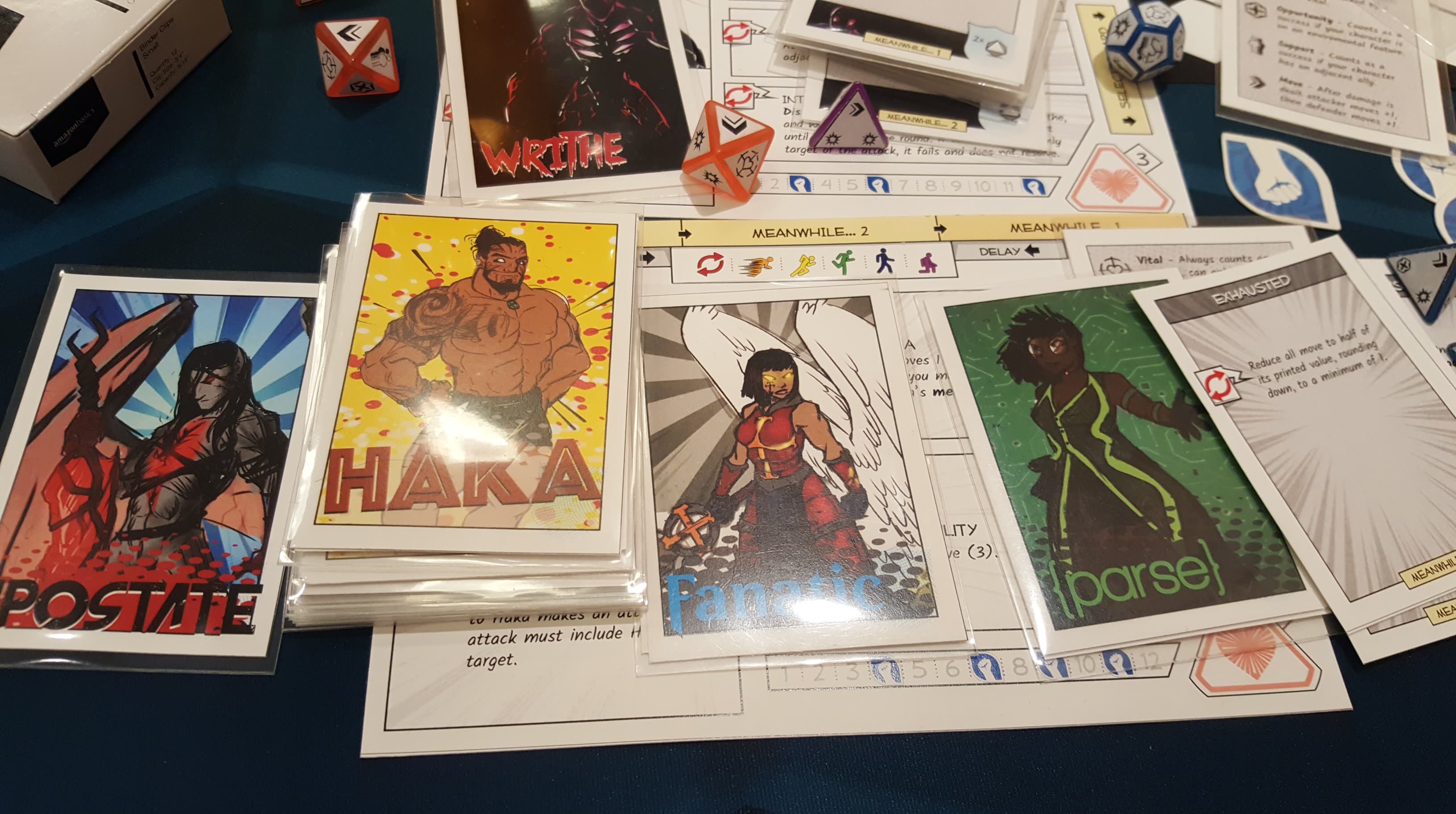
Several Character cards
Some Trophy cards and boards (All art and layout subject to change)

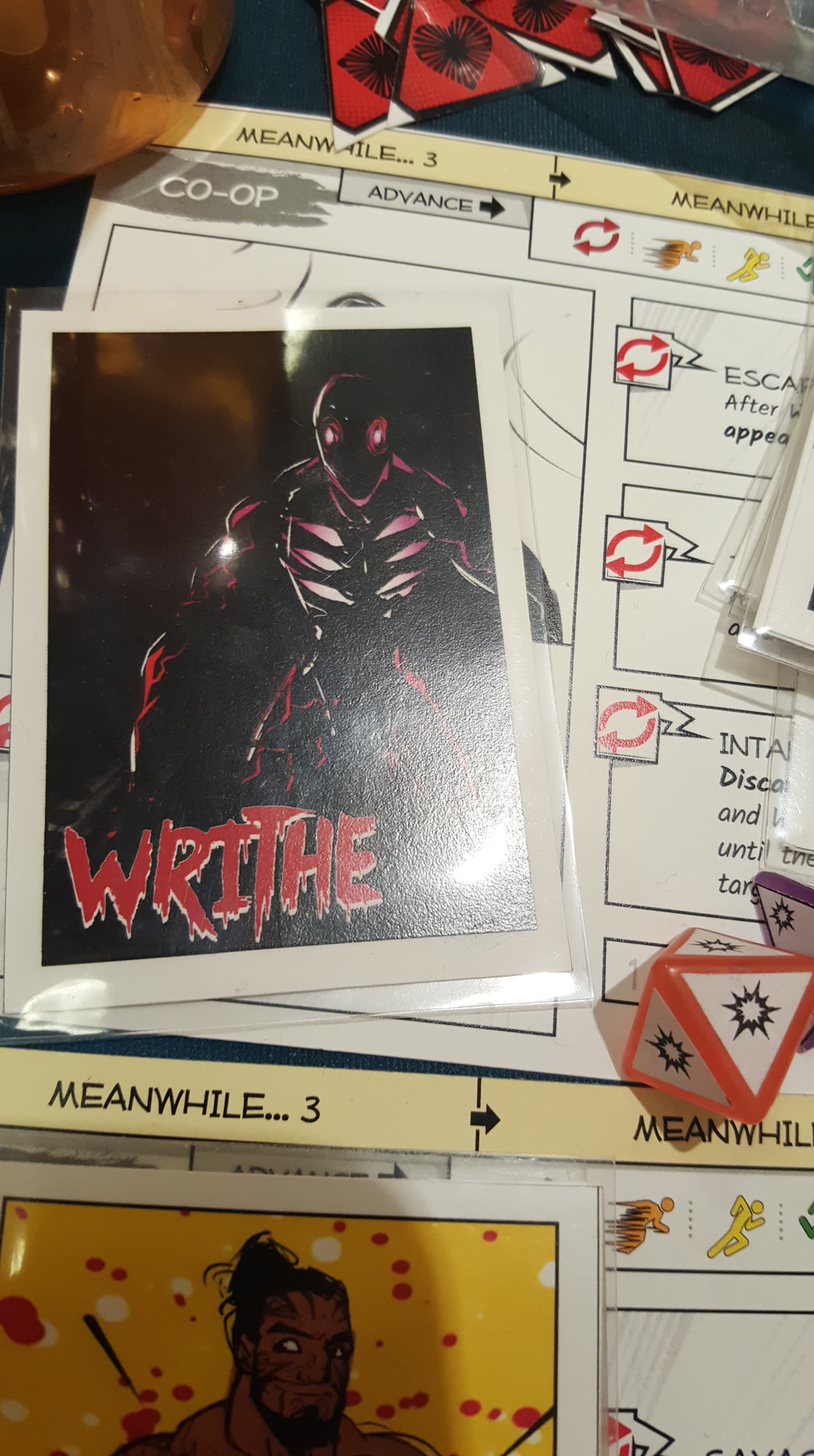
Writhe
Writhe! so spooky. (All art and layout subject to change)

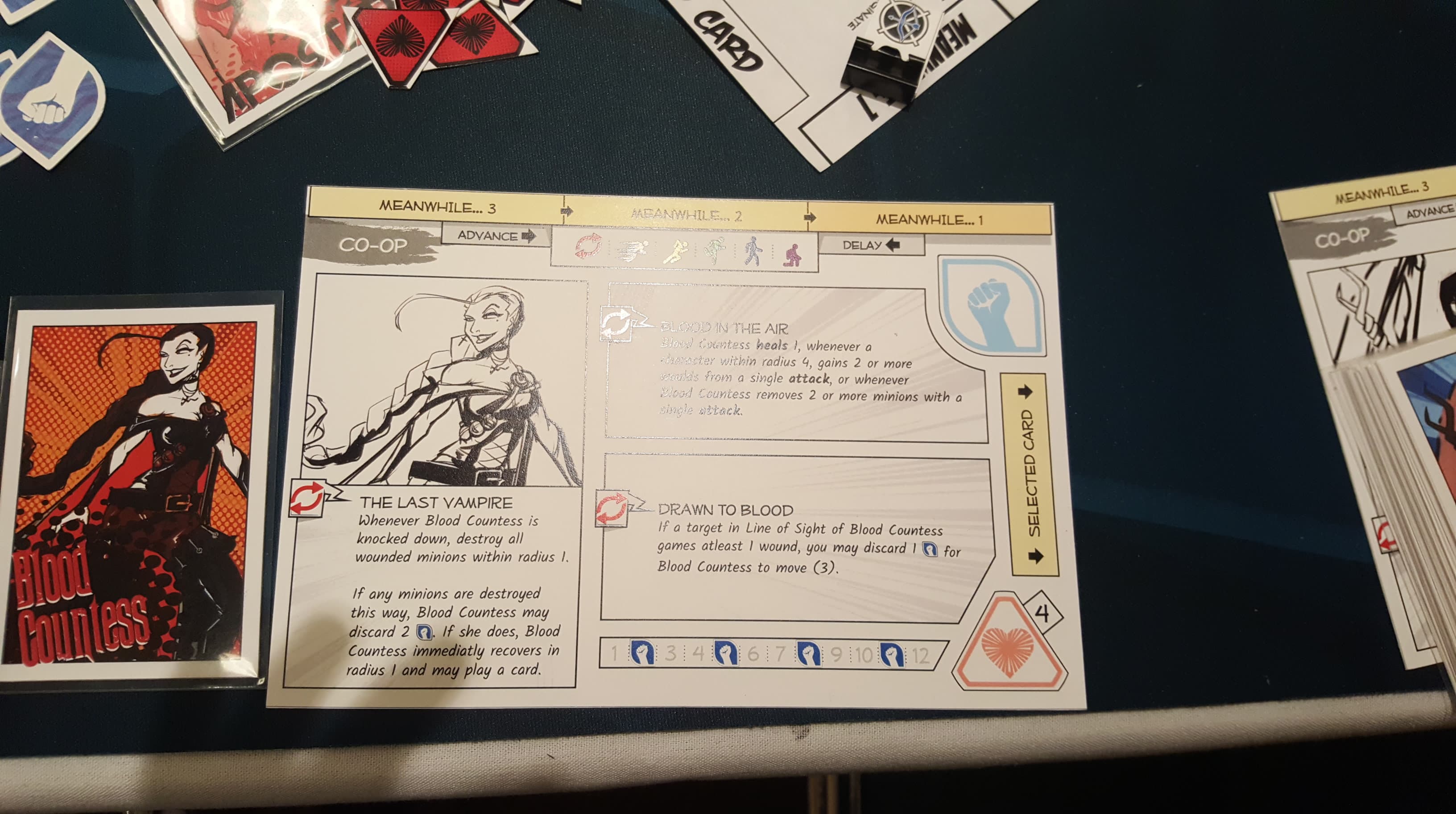
Blood Countess Upside Down
Blood Countess Board and Trophy card (All art and layout subject to change)

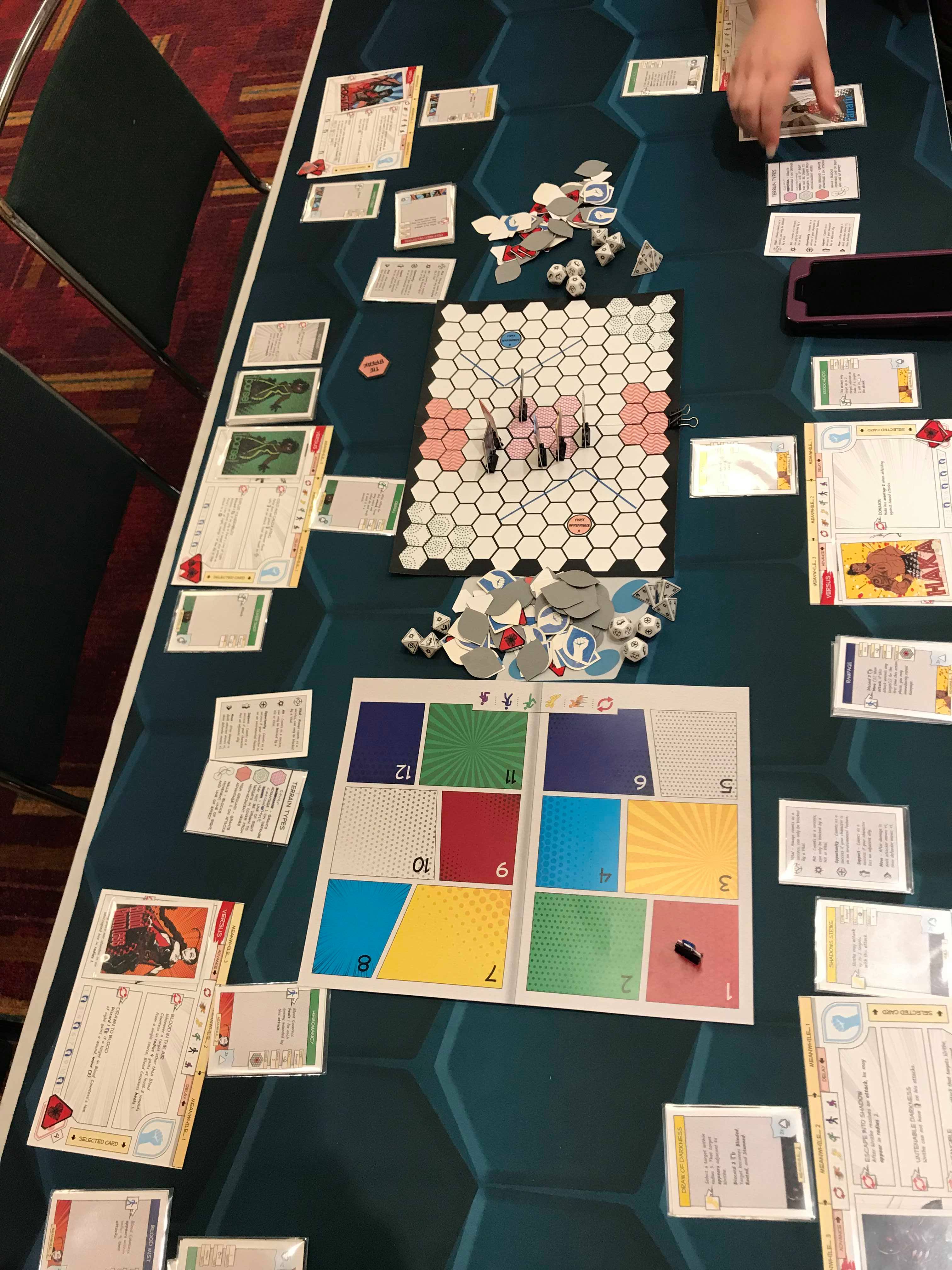
PvP full Table
Versus mode Teaching Round setup (All art, component design, and layout subject to change)

It’s been almost two months, but the ghost of Gen Con content still lingers, oooOoOOooh.

Now that you’ve gotten to see what was shown off at Gen Con, let’s talk a little about how the development process works for Prime War. For the first few months of design, we created the core system, characters, and scenarios in-house in our VA Beach headquarters. We then brought all of that content to >G in St. Louis, where they refined some of the system, most of the characters, and a little of each scenario arc. That was the true beginning of the current development cycle of Prime War. What generally happens now is that we design a new thing (or iterate a bit on an existing environment/scenario), and we write on some cards so we can play it really fast to make sure it works in practice as well as it seems in our heads. We’ll then plop it into our Google Sheets -> InDesign -> TTS/PnP prototyping pipeline, and send it off to >G staff and the >G playtesters, generally on a weekly/bi-weekly basis. We’ll ask the playtesters to try things out and give us some feedback within a week or so, a turnaround about which they’ve been pretty good. We’ll then take that feedback and iterate on that thing while giving the material we were working on during the previous cycle, and on it goes!

Every month or so, >G will have a flurry of in-house testing of a particular scenario, an environment, or a new way of wording a particular rule or set of rules which they then communicate to us; generally, they include the reason for their concern, what feedback they got from their staff, and what changes they made to accommodate the concerns, be they due to production costs, marketing, graphic design and layout, story, mechanics, or rules interpretations. We’ve been pretty understanding of the majority of the changes, and asked for clarifying information when we’re unclear as to the issue or the proposed solution, and occasionally stood our ground when a change would have contradicted the goals or the core of the game. (We’re sometimes told very gently that the game needs to morph in order to be a product, and we pout like babies and give a big dramatic ugh, fiiiine, I guess… when this happens [= then we all agree as to what will make the game the best it can be)

We have visited St. Louis every 7-8 months or so since development started to have a time when both teams can focus on Prime War (we take vacation time from day jobs, and >G staff take most of the week) and address concerns, clarify design objectives, and discuss next steps. We also check in at Gen Con and PAX Unplugged to make sure we’re still in line to meet any goals. >G has a lot of oversight over Prime War, and sees every piece of content we produce, as well as all feedback from playtesters. The only true bottleneck in the process is having the time from Christopher and Adam to clarify lore points, but those are mostly ancillary to the actual development work, changing minor plot for scenarios or environments at this point, as most of the characters are solid mechanically and thematically.

Some of you have asked about videos or streams of previews, and we’d love to do some! I think >G has some plans to do character previews (as they’ve started doing for Spirit Island Spirits), so we will coordinate with them to make sure we’re not doubling anyone’s workload. Our game room doesn’t have nearly the quality of equipment that >G has, but we could potentially do some live play videos of some gameplay, and/or some commentated recordings of play, either through Tabletop Simulator or our physical components.

Similarly, we’d love to start putting up some posts about the characters, and potentially the environments. These would all need to be taken with an enormous grain of salt, as nothing is truly canon until posted, published, or podcasted by >G themselves; however, we could definitely talk about where each concept started and how they grew, both mechanically and thematically, into whatever the current iteration is. As the bulk of development from now on is going to be scenarios, and we’d like most of that to be a surprise when you open the mission packs, we probably won’t talk about any scenario design until after the game’s release.

We understand there’s some concern regarding >G’s workload and process as it could impact Prime War after a recent Legends of Sleepy Hollow update, and we want to let everyone know we’re unlikely to see any additional delays with these announcements. We have every faith that >G will buckle down and get both Legends of Sleepy Hollow and the Sentinel Comics Role-Playing Game up to standards and out the door (in that order) as soon as possible, and that Prime War will be tight on their heels with the same level of care and attention.

–Smith at the Forge

Development Progress:(all values are rough estimates from our perspective as designers, and do not include any art, layout, editing, or proofreading work still necessary) Sorry we forgot this in the last post!

Core Box:
Characters 95%
Versus Scenarios (3×3) 20%
Co-op Scenarios (3×3) 60%
System (rules, dice, maps, environments) 95%
Co-op system(rules, threat/boss structure) 95%
Component list: 65%
Rule Book 60% (Phrasing, order of teaching, examples)
Expansion 1:
Characters 95%
Versus Scenarios (2×3) 20%
Co-op Scenarios (3+3+5) 55%
Conversion Kit:
Characters (9 FoF + 6 UR) 90%
Scenario Maps 30%

Featured

Post-Gen Con Update

Three weeks later…

Hello everyone!

This year’s Gen con was an absolute blast, not the least of which was seeing people show up to our (almost sold out) ticketed events! Many thanks to all of you who came out to play Prime War and give feedback, your input was greatly appreciated, even if it was as simple as “That was fun!”.

After demoing Versus and Cooperative modes for roughly 80 people, we got a lot of feedback about how people felt about the system, the characters, and the game modes. The few people who got to play both modes over the weekend mentioned that cooperative play was noticeably more complex and felt a lot slower than the Versus play. While we were there, we made some tweaks between demos to attempt to streamline and speed up cooperative play, and we took notes about what players were enjoying and what was a headache so we could take that information home for reworks.
We’ve been working on new Cooperative material for the last few weeks, focused on drawing Cooperative play more in line with Versus play by reducing the additional rules overhead, removing half of the target selection calculation process when minions act, reducing the number of targets on the map at one time, and focusing more on heftier, character-level targets as threats to oppose the players. We played through a few games with the new Threats and had a ton of fun; the new format was running matches about 45 minutes for us, which was a significant decrease from the 1.5 – 2 hour matches we were previously playing. Some characters felt wimpy or outright useless in the previous version of cooperative play, but by shifting the focus from hordes of minions to small teams of character-level threats, we’ve brought everyone back to where they were designed to be: key players in high-stakes superhuman tactical combat.

We’re really excited about these modifications and we’ve given the new materials to the playtesters, so we’ll be evaluating their feedback over the next few weeks as we update the scenario materials for the cooperative missions. Very little of the narrative or objectives will need to change with this new update, so we will be moving pretty quickly as playtesters give us feedback. If you would like to playtest Prime War, be on the lookout for announcements coming from Greater Than Games asking for new testers. It’s not for everyone, as it involves playing a lot of material that is broken, unfinished, and lacking polish; however, all feedback is invaluable to us, as it helps make the game better.

We once again thank you all for your patience with this process, especially as it may seem to be dragging lately. We’re invested in making both modes of play into a fun experience for everyone who is interested, and that involves a lot of fine-tuning and revisions to make sure it’s as good as can be. We’ve been hesitant to mention anything about a timeline here, as that’s much more in Greater Than Games’ wheelhouse, and they have considerably more experience than we do in this arena. Lore Forge Games wants to make sure that we have everything done mechanically and thematically before we make any announcements regarding dates, and we’re just not there yet. The Cooperative play looks like its in a fairly good place with this latest update, and we’re hoping that playtesters are willing and able to jump in with both feet to help us push this down the track.

Until next time,

–Smith at the Forge

Featured

New Co-op and Gen Con Hype!

Welcome back, all you dashing and/or dastardly!

We mentioned in our last update that we settled on a new system for co-operative play, and (fingers crossed) we can say this is the one that will be in the box. There’s still a few minor things to work out in terms of edge cases, and we have to re-balance all of the scenarios we had in the pipeline as well as find a fun “cobble-together-your-own-game” mode for those of you who just want to throw down at the end of a day, but it’s coming along nicely. We also fleshed out a structure of content generation that will hopefully get more eyes on more of the scenarios so that each pre-packaged scenario is rich to experience and actually fun to play.

Something even more exciting, though: YOU, yes, you, can come see/touch/play both modes of Prime War for 2 whole hours on Thursday, Friday, or Saturday at Gen Con! At the time of this writing, there are still several slots open on Thursday, and one on Friday, with both of our Versus and Co-operative demos on Saturday already full up! However, for those of you who were not able to get in on the scheduled demos this year, please feel free to come drop by the demo room (Room 140) and say hello, and we’ll try to give you an overview of what the game is all about.

Smith at the Forge

Development Progress:(all values are rough estimates from our perspective as designers, and do not include any art, layout, editing, or proofreading work still necessary)

Core Box:
Characters 95%
Versus Scenarios (3×3) 20%
Co-op Scenarios (3×3) 50%
System (rules, dice, maps, environments) 90%
Co-op system(rules, threat/boss structure) 85%
Expansion 1:
Characters 95%
Versus Scenarios (2×3) 20%
Co-op Scenarios (3+3+5) 45%
Conversion Kit:
Characters (9 FoF + 6 UR) 90%
Scenario Maps 30%

Featured

Pride, Publishers, and Playtesting

Hey all,

We are terribly sorry for our lack of updates over the last few months. We’ve been caught up with day jobs and preparing materials on our end to get everything ready for the demos at Gen Con.

We recently came back from a week of meetings with Greater Than Games to help clarify and resolve some of the more ambiguous pieces of the support mechanic and the co-operative mode to make sure that new players have as few barriers to play as possible. We’ve been working on this system for a little over two years now, and we were skeptical that changes were needed, as we had been very comfortable with the system for the last several months. However, a good developer brings things to a designer that are problematic, and a good publisher has an eye out for what may turn new players off. In >G, we are incredibly lucky to have both, as well as an uncompromising desire for this game to be the best that it can be. There were some hard discussions about complexity and demographic reach that helped us to realize that Prime War needed to be more than just a fun game for us, and therefore needed to evolve in a couple of areas in order to really blossom.

All that to say: Co-operative play is getting one more facelift; and after this week, we’re glad that >G pushed for another iteration, because we may have very well been complacent and content with the previous version. The new structure is more fully integrated with the activation phases that characters use, simplifies minion math and management, and is a little more intuitive for new players. We’re still putting it through its paces in order to fully evaluate its capability and to iron out any new snags that may have cropped up in the modifications, and after that, we’ll get to updating the existing scenarios to work with the new system. It’s been a long and contentious journey to this version of co-op play, but initial feedback from >G playtests have been incredibly promising.

We want to be very clear to anyone who has some anxiety about what may sound like us bending over backward for the Co-operative mode: nothing is being sacrificed from Versus play in order to make Co-op better. This will always be an excellent team vs. team game for those of you who want to match wits and cunning against your foes at the other end of the table. The simple truth has always been (and continues to be) that co-operative play is an incredibly frustrating thing to get just right, and therefore needs a little more attention paid to its inner workings. The core rules that govern rounds, combat, movement, Meanwhile, and terrain are all super solid and create a really fun playground to try different team compositions, strategies, and combos for new and veteran players alike!

We also got to discuss some neat options for possible content to go in the box, but we’ve been told that is heavily dependent on the quotes that are received from the manufacturer. Learning things about the board game industry is always fun and weird… This is also one of the reasons we’ve been hesitant to talk about any of the specific scenario content, as we’re incredibly unsure about what will all make it into the final boxes, at least for the next couple of months.

Once again, our sincerest apologies for the radio silence. We know you are all just as eager to hear about Prime War as we are to tell you about it, and we’re sorry we haven’t been able to keep you as up to date as either of us would like. We’re hopeful that at Gen Con we’ll be able to show off some fancy assets, and by the end of the year you’ll be able to see some neato promotional material that we had some fun talks about this week!

Smith at the Forge

Development Progress:(all values are rough estimates from our perspective as designers, and do not include any art, layout, editing, or proofreading work still necessary)

Core Box:
Characters 95%
Versus Scenarios (3×3) 20%
Co-op Scenarios (3×3) 50% (restructuring of co-op system re-set some progress here)
System (rules, dice, maps, environments) 85%
Co-op system(rules, threat/boss structure) 85%
Expansion 1:
Characters 95%
Versus Scenarios (2×3) 20%
Co-op Scenarios (3+3+5) 45% (restructuring of co-op system re-set some progress here)
Conversion Kit:
Characters (9 FoF + 6 UR) 90%
Scenario Maps 30%

Featured

Tantalizing Tidbits

Hello sidekicks and minions, today we’re going to try to stoke your interest and quench your curiosity.

The tale of Prime War is a bit outside the normal stories of Sentinel Comics, due to the fact that the story doesn’t truly focus on the characters we’ve come to know, heroes or villains though they may be. Prime War is much more so the story of the Prime Aspects and their conflict over that no-land’s land, that place where nothing matters and everything is possible: Ur-Space. The Prime Aspects are vying for control in this place because of its unique position in the multiverse; namely, that from here one can go anywhere, given enough power. The story told within the PvP missions of Prime War games and tournaments is that of the conflict between the Aspects through their chosen standard bearers. Players will take the reins of a character in service to their aspect, and show dominance through objective-based combat in order to advance their faction’s cause. The co-op missions, on the other hand, tell the story of the various adversaries that threaten multiple realities, and how the Aspects send their adherents to shut down these existential dangers. These might be a power-mad Cult of Gloom trying to break out of a world they’ve already dominated, an entire universe of infected trying to spread the Rat Plague to another reality, or some things even more sinister and creepy! One of our favorite parts of playing with multiple realities is that we get to see how some things become gross, awe-inspiring, and occasionally disturbing when left unchecked. Not every mission will be an overblown “What-If” universe, as the Aspects will stop anything that threatens their dominance over the space between worlds, no matter where it comes from.

The mechanics of Prime War have evolved from a few different things over the last 2 years or so. Starting from Sentinel Tactics, which introduced us to character-based team PvP in a board game setting, we sought to build a system that could support this team-centered approach, with interplay between teammates’ abilities in order to maximize a character’s abilities. We also liked Character boards with unique abilities, playable power cards, player recovery instead of elimination, the hexagonal map system, and combat that was influenced by dice rolls, so we decided to use those aspects; however, we did away with multiple elevations of terrain and introduced custom dice that have binary success/conditional success states, instead of the numeric scale used for range and power in Sentinel Tactics.

We also had a big influence from an excellent video game called Atlas Reactor, which is also a character focused team tactical game. Atlas Reactor featured simultaneous action selection with action speed-based executions per round, additional bonus abilities that characters could bring into a match for one-time use effects, a resource system for a character to access their fancier abilities, map-based pickups that can enhance specific statistics of a character for a short time, and a cooldown mechanic for most abilities so they could not be used every round.

We really gelled with a restriction on ability re-use (especially coming from high-level Tactics play, where some characters could consistently pour 20+ dice per turn on attacks), so we incorporated a Meanwhile mechanic to Prime War that allows some more powerful abilities to be restricted to less-frequent use.

Player downtime was a huge sticking point for us, and the simultaneous action decision space was an excellent way to combat the waiting that players encountered on others’ turns. Players now all secretly select the action their character is taking that turn, and all players reveal their selected action simultaneously. Play then proceeds, with every action taking place during its defined Action Phase, and the potential for analysis paralysis is vastly reduced.

Neutral objectives (like map pickups) were a large focus for us since day one, as we wanted to help encourage players to fight in and over specific areas on a map over time, and not just rush to the center and slug it out; therefore, we built a robust environmental objective system that players can use in their own skirmishes to enhance their regular play.

We wanted each character to behave differently, and their fighting styles to be reflected in how they gain and spend the mechanical resource (currently) called Focus; consequently, we’ve allowed each character to gain some focus over time, as well as some characters gaining additional focus for playing to their strengths. This Focus can be spent to fuel reactions, manipulate cards in a character’s meanwhile, or to unleash devastating abilities.

Additionally, we made a mechanical representation of how Prime Aspects grant their champions power for each match in order to help them accomplish their goal. These Boons can have a number of effects, and are effective at helping characters play outside of their natural role in order to shore up a team’s weakness or enhancing a character’s strengths to allow their team domination over the field.

A few more major mechanics that had more nebulous influences were a Panel tracker, Trophy cards, Rally abilities, and the mechanics governing co-op adversaries. The Panel tracker represents the comic book that we’re playing through, and helps establish when a match is over, when players gain Focus, when threats spawn, and when some scenario events happen. Trophy cards are a method of tracking victory, where each character starts with their own, and must give it up to the character that knocks them down. The giving of a Trophy card also reveals that character’s Rally ability, which encapsulates that character’s determination to finish the fight, often by drastic means. The mechanics of Co-op Threats and Bosses are slightly in-depth for what has turned out to be a rather long post as it is, so we’ll save that for another time, but suffice to say we strove for simplicity and spectacle when pitting players against the multiverse’s adversaries.


Development Progress:(all values are rough estimates from our perspective as designers, and do not include any art, layout, editing, or proofreading work still necessary)

  • Core Box:
    • Characters 95%
    • PvP Scenarios (3×3) 20%
    • Co-op Scenarios (3×3) 50%
    • System (rules, dice, maps) 90%
  • Expansion 1:
    • Characters 95%
    • PvP Scenarios (2×3) 10%
    • Co-op Scenarios (3+3+5) 25%
  • Conversion Kit:
    • Characters (9 FoF + 6 UR) 30%
    • Scenario Maps 30%
Featured

New year, new stories

Welcome to the new year!

We are so excited that you are all joining us for another year of nonsense and nonsensibility. This month we wanted to give a development update on co-op and competitive scenario play, as well as talk a little bit about working with the established characters from the Sentinels canon in this new medium.

Real quick: not everything is finalized, so some things mentioned here and in previous posts may see changes before the game ships.

We are rocketing through scenario development for co-op in the hopes of getting everything ready for art next month. We have three mission arcs with three or four scenarios in each in the core box, and three more mission arcs in the day-one expansion. So far, we’re on to “final” playtesting on two mission arcs, and are chugging through the third arc.

Co-op scenarios in Prime War are going to be objective-driven fights, with a strategic element similar to the Sentinels of the Multiverse card game. The player characters (as not everyone is a “hero” these days) are coming up against Adversaries that challenge them to think in a variety of ways to thwart the various plots and schemes throughout the various realities that we explore in Prime War. That’s not to say that there aren’t some scenarios that focus on the players plowing through waves of minions; however, most scenarios use that as a backdrop for shutting down portals, escorting civilians, analyzing infections, rescuing familiar faces, or dishing out some damage to the Big Bad. We want to engage many playstyles in our cooperative missions, so there’s options for every character to shine in some capacity, showing off why they were chosen by the Prime Aspects.

PvP scenarios in Prime War look a little different. We want to pit two teams against each other through multiple match types. The core box features a series of Capture the Flag matches, King of the Hill and Capture Point matches, and some neat variations on the classic Deathmatch-style match type. We’re working through these internally at the moment, and will be bringing these to playtesters as co-op playtesting winds down.

Each of the characters in the Sentinel Comics canon is fascinating in their own way, and we’ve been incredibly privileged to be allowed to play around in this sandbox. When we were first working on these characters, we were looking to represent three major things: who they were; what they have become; and how it feels to read about these characters as a fan. With only a character board and seven unique cards, it was essential to capture the most memorable aspects of each character while portraying how they show up in a primarily combat-centric setting. Some characters jumped out right away, telling us exactly how they would be expressed (Tempest, Blood Countess, Argent Adept), and some took a little more digging (Haka, Man-Grove); however, they’ve each been boiled down to the greatest hits to keep every card fresh and useful in a variety of situations.

We’re excited and anxious about the stories we’re telling through the scenarios and the characters themselves, and we can’t wait to have you all join in the fun we’ve been having! Thank you all for your continued interest and support!

Smith at the Forge

-P.S. Feel free to chime in with what you want to hear about next! We’re cooking up one about how we translated some of the characters from the SotM card game, but that might get detailed and therefore delayed until some other things become public.

Featured

The Con Days Are Over, the Con Days are Done

We had an excellent weekend at PAX Unplugged demo-ing the co-op mode of Prime War, and we’re very grateful for everyone who came out to play with us!

Since our last showing at Gen Con, we’ve gone to St. Louis to meet with Greater Than Games, finalized a lot of character work, and revamped the threat system for Co-op play.

Co-op’s major change from the Gen Con preview is that threats can now act either before or after a player’s action. Previously, the threats always acted before a player, and were able to interrupt player’s choices pretty significantly; now, the majority of Threat cards activate after the player’s action, and only truly surprising or significant threats act before the player. We also simplified the threat’s targeting structure, allowing players to manipulate who is being targeted by which threats and reducing the amount of “ganging up” that was seen at Gen Con. All of these changes led to a system that is now much more friendly and fun! The playtesters have been working through the first mission arc of the co-op story (the first scenario of which we demoed at PAX Unplugged), and everything seems to be going very well so far.

The characters have been fairly solid, without changes, for about a month now, with playtesters reporting a fairly even win rate in competitive play with characters regardless of allies or enemy teams. Currently, we are toying with some enhancements to character’s methods of movement, as most scenario play sees a lot of use from the movement card and we wanted to make sure players never feel like they are “wasting” a card play. This will necessitate another round of re-balancing; however, these enhancements are not intended to shake up the combat style or complexity of a character, so the level of impact on balance and power level should be fairly minor, and allow for rapid iteration and finalization.

We got to play a “high level” competitive match while we were in St. Louis, which only whetted our appetite for the potential competitive scene. We brought the Prime Aspect’s Boons into play, giving every character an interesting and powerful augmentation to their own abilities and allowing for more varied and clever tactical choices to be made by each team. While we were there, we also tested our mettle against some of the Bosses of Prime War’s co-operative mode, taking the fight to some recognizable, but wildly different, faces from across the disparate realities. There was also an incredibly productive meeting about the graphic design of the iconography and layout, as well as the component design of the maps, scenario books, threat and environment tokens, and box shape.

Now that we’re not constantly cramming for Cons, there should be a more regular structure to our updates here, many apologies for being in the dark for the last few months. Feel free to let us know what you want to hear about, and we might make that the focus of our next post!

I cannot express enough thanks to the playtesters who have gotten us this far, and the intrepid souls who ventured into the Block with us this weekend to try out Co-op! You are all super in my book.

–Smith at the Forge

Featured

Gen Con Debrief

Whew! Everyone’s home, mostly recovered from Con Crud and lost sleep, and ready to get back at it!

We are extremely grateful to everyone who came by the >G demo room to check out Prime War; your experiences and feedback was invaluable to our process moving forward. We learned a few things about the “best” way to demo Prime War that will influence the structure of the rulebook, as well as what we bring to PAX Unplugged later this year. We got a chance to run two dozen or so team deathmatch games, including a small handful of 3v3 matches that were truly a spectacle to behold!

Several of you were brave enough to try out Co-op play, and we are incredibly grateful for your time and patience. Many of you expressed your excitement that your were able to fight alongside your friends, and some were disappointed in the timing of some of the enemies’ actions. We’ve taken all of the feedback we’ve gotten from everyone and are looking to tweak some of how the threats behave in order to reduce the frequency of dead rounds. Being Knocked Down is a staple of the game, and should be present in the co-operative play; however, it is currently almost always preventing player actions, whereas that is much less common in PvP play.

We’re excited to start a new round of playtesting in the coming weeks, with major foci on polishing the core box characters and finalizing the co-op threat system. We will also start introducing more scenario play, built from the modular environmental objective system that some of you got to see.

Once again, excessive amounts of gratitude for those of you who came to play Prime War, we are truly overwhelmed by your graciousness and enthusiasm!

Until next time,
–Smith at the Forge